
WEBSITE DEVELOPMENT
Build a website with purpose, structure, and a better experience for the people using it.
A well-built website brings together your story, content, design, functionality, and technical foundation to create a digital experience that works for your audience and supports what you want the website to accomplish.
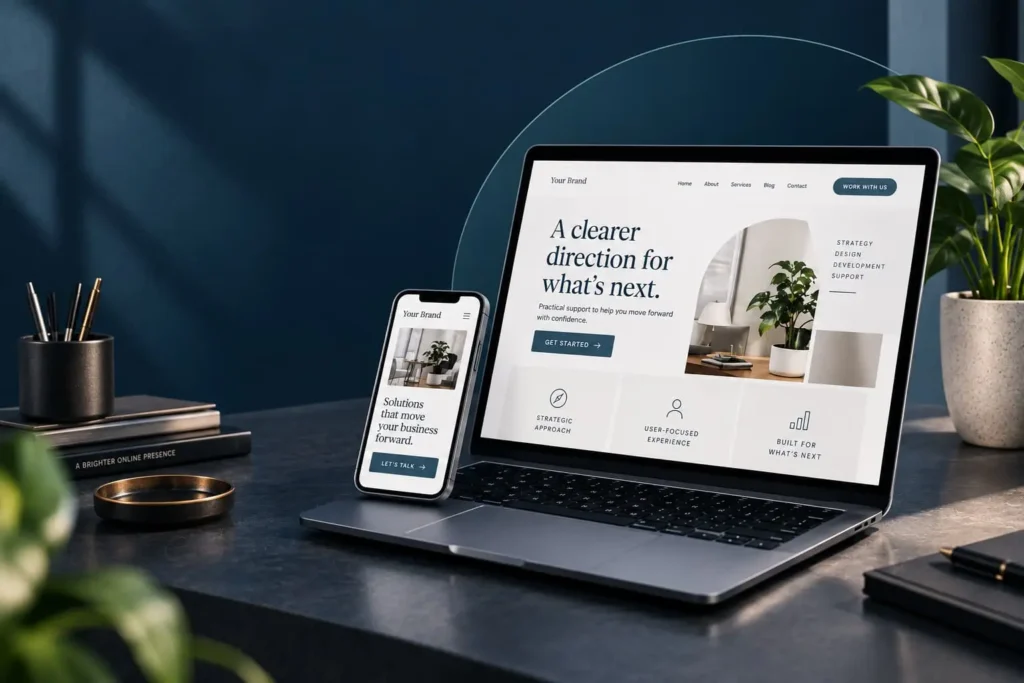
WHAT MAKES A GOOD WEBSITE?
A great website does more than list pages and services.
A website is a digital space where your audience can understand who you are, what you offer, and why it matters.
The strongest websites don’t simply present information. They bring together story, structure, design, usability, and clear next steps to create an experience that makes sense to the people visiting them.
The Role of Storytelling
- Builds connection
- Your story can help visitors understand who you are, what you value, and what makes your approach different.
- Communicates purpose
- Your website can explain why you exist, what you provide, and who you are trying to reach.
- Creates distinction
- Your experience, perspective, and approach can make your website more memorable than a generic list of features or services.
What Should Work Alongside Your Story?
- Clear navigation
- Visitors should be able to find the information they’re looking for without having to work through a confusing structure.
- Information hierarchy
- Content should be organized so visitors can understand what matters and where to look next.
- Clear calls to action
- When there is a logical next step, make it easy to identify — whether that’s contacting you, booking, applying, registering, purchasing, or exploring more information.
- Responsive experience
- The website should remain usable and visually coherent across desktop, tablet, and mobile.
WEBSITE FOUNDATION
Good design gets attention. Good development makes the website work.
A website can look polished and still provide a poor experience if the underlying structure and functionality haven’t been properly considered.
During development, different parts of the website need to work together.
This can include:
- Structure
- Organizing pages, content, navigation, and information so the website has a logical foundation.
- Responsive Development
- Creating layouts that adapt to different screen sizes and remain usable across devices.
- Performance
- Considering page structure, images, media, scripts, and other elements that can affect how efficiently the website loads and functions.
- Accessibility
- Considering how different people interact with the website, including readable content, appropriate contrast, meaningful structure, and usable interactions.
- Functionality
- Making sure forms, booking systems, e-commerce, interactive elements, and other required features work as intended.
- Integrations
- Connecting the website with relevant tools, platforms, and systems when the project requires them.
- Testing
- Checking pages, links, forms, responsive behavior, functionality, and key user journeys before launch.
The visual design is only one part of the website.
The structure underneath it matters too.
WEBSITE + SEO
Build your SEO foundation into the website from the start.
SEO doesn’t have to be something you think about only after your website goes live.
During development, foundational SEO considerations can be incorporated into the website structure and content.
This can include:
- Page titles
- Meta descriptions
- Heading structure
- Image alt text
- URL structure
- Internal linking
- Relevant keywords
- Mobile-friendly structure
- Basic technical SEO considerations
These elements form part of the SEO foundation of your website.
That doesn’t mean your website will automatically rank or appear at the top of search results.
SEO takes time and requires ongoing work.
But incorporating the foundation during development means you’re not starting the SEO conversation from scratch after launch.
WEBSITE + USER EXPERIENCE
Design the journey, not just the individual pages.
Visitors rarely experience your website one page at a time in isolation.
They move through information.
They arrive somewhere, look for context, explore, make decisions, and determine what to do next.
That means the relationship between your pages matters.
A thoughtful website considers:
- What visitors need to know first
- How information is grouped
- Where visitors can go next
- Which actions should be prominent
- How pages connect with one another
- What happens when someone submits a form
- How the experience changes on mobile
The goal is to create a website that feels clear and intentional, rather than simply putting information online.
WEBSITE + FUNNEL
Your website and funnel can work as part of the same digital system.
Your website can provide the broader experience — helping people understand you, explore your work, and find the information they need.
A funnel can then support a more specific journey.
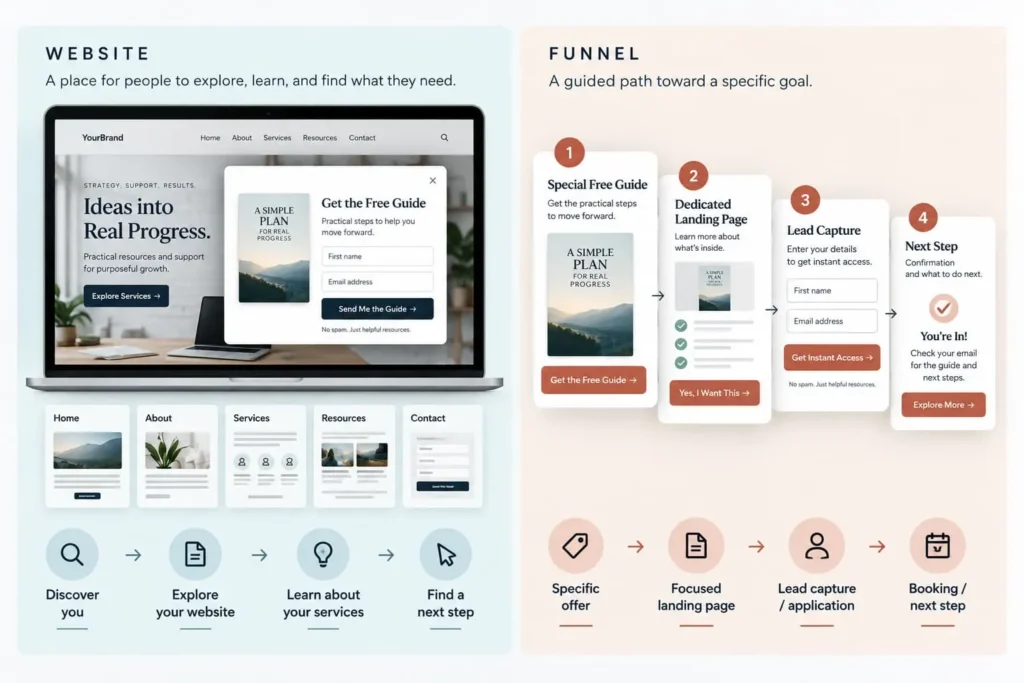
Your website helps people explore. Your funnel helps move them forward.
A website can give visitors the information they need to understand you and your offering. A funnel can take care of the next steps in a defined journey — even when you’re not online.
Once the funnel is set up, it can present the information, collect details, deliver a resource, send follow-up emails, and direct people toward the next step without you having to manually respond to every inquiry.
You don’t have to be online every time someone takes an interest.
The funnel can keep the process moving while you’re offline, so when you come back, you can focus on the people who are ready for the next conversation.
WHAT I CAN HELP WITH
From planning and design to development and launch.
Depending on the project, website development can include:
- Website planning and structure
- Information architecture
- Page development
- Responsive design
- Navigation
- Content organization
- Calls to action
- Forms and lead capture
- Booking functionality
- E-commerce functionality
- Basic SEO implementation
- Integrations
- Mobile optimization
- Testing and quality checks
- Website launch
The exact scope depends on the website, its purpose, functionality, and requirements.
HOW THE PROCESS WORKS
From requirements to a working website.
1 — Understand
We look at the purpose of the website, audience, goals, content, functionality, and project requirements.
2 — Plan
We determine the website structure, pages, navigation, content organization, and required functionality.
3 — Design
The visual direction, layouts, hierarchy, and user experience are developed around the structure.
4 — Build
The website pages, responsive layouts, functionality, and required integrations are developed.
5 — Optimize & Test
The website is reviewed for responsive behavior, navigation, forms, links, functionality, foundational SEO, and key user journeys.
6 — Launch
Once the website has been reviewed and everything is ready, it goes live.
WEBSITE EXAMPLES / PORTFOLIO
See how the work comes together.
Every website has a different purpose, audience, and set of requirements.
Show examples of websites you’ve developed, redesigned, or contributed to and explain what you worked on for each project.
For each project, you can show:
- Project
- Name of the website or project
- Purpose
- What the website was designed to accomplish
- My Role
- What you actually handled
- Scope
- Design / Development / Redesign / SEO / Functionality / Other relevant work
WEBSITE + YOUR DIGITAL PRESENCE
Your website can become the central place for your digital presence.
People may discover you through different channels — social media, search, referrals, advertising, email, or other platforms.
Your website gives those visitors a place to go deeper.
They can learn about you, explore your work or services, access resources, complete an action, or find a way to get in touch.
Your website can also connect with other parts of your digital system.
This can include:
- Social media
- Search and SEO
- Email marketing
- Funnels
- Booking platforms
- Forms
- E-commerce
- Other business or digital tools
Instead of treating each platform as a separate piece, your website can help connect the experience together.
QUESTIONS YOU MIGHT HAVE
A few things you might be wondering.
Can you build a website from scratch?
Yes. The website can be planned and developed around its purpose, audience, content, functionality, and requirements.
Can you work with my existing website?
Depending on what you need, an existing website may be redesigned, updated, expanded, or improved rather than completely rebuilt.
Can you build different types of websites?
Yes. The structure and functionality can vary depending on the project, whether it’s for a business, school, organization, professional, portfolio, personal project, or another purpose.
Will my website be SEO-ready?
Foundational SEO considerations can be incorporated during development, including page titles, heading structure, image alt text, URL structure, internal linking, and other relevant elements.
SEO-ready does not mean guaranteed rankings. Search visibility requires ongoing SEO work and time.
Can my website connect to a funnel?
Yes. A website and funnel can work together. Your website can provide the broader experience while a funnel guides visitors through a more specific journey.
Can you add booking, forms, or other functionality?
Yes, depending on the functionality required and the tools or integrations involved.
What if I don't know exactly what my website needs?
That’s okay. The first step is understanding what the website needs to accomplish. From there, we can determine the structure, content, functionality, and other requirements.
Do I need to provide all the content?
That depends on the project and scope. We can determine what content you already have, what needs to be organized, and what may still need to be prepared before development.
Ready to build a website with purpose?
Whether you’re starting from scratch, redesigning an existing website, or trying to improve how your current site works, the first step is understanding what you need the website to accomplish.