
FUNNEL DESIGN & DEVELOPMENT
Build a clearer path from visitor to inquiry, application, booking, or registration.
A funnel gives potential customers a structured way to learn about your offer, take the next step, and move through the customer journey without relying on manual guidance at every stage.
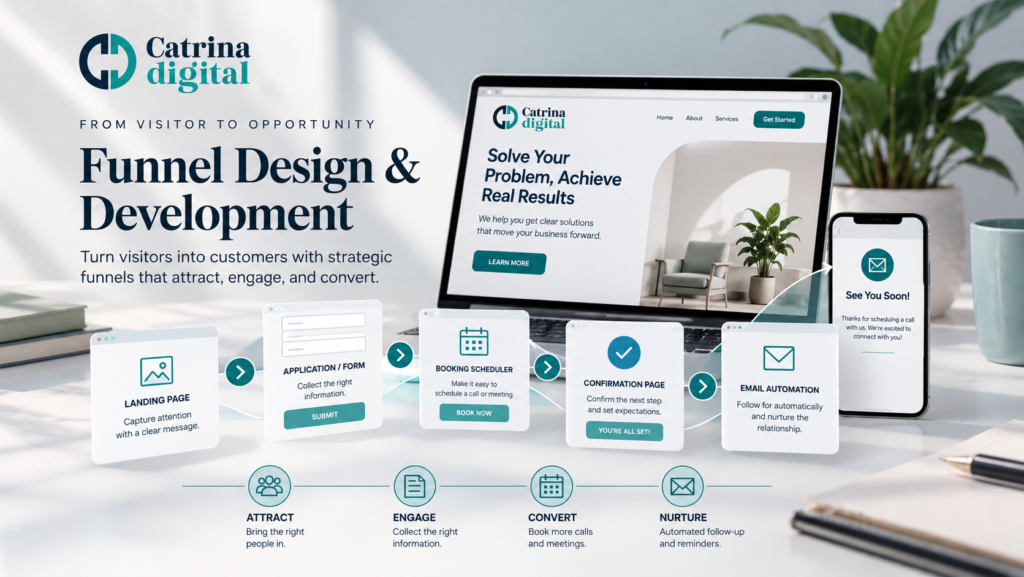
WHAT IS A FUNNEL?
What exactly is a funnel?
A funnel is a structured customer journey that guides someone from their first interaction with your business toward a specific next step.
That next step might be submitting an inquiry, downloading a resource, completing an application, booking a call, registering for an event, or making a purchase.
Instead of leaving visitors to figure out what to do next, a well-planned funnel gives them a clear path to follow.
WHY A BUSINESS MIGHT USE A FUNNEL?
Give interested people a clear next step.
People may discover your business through social media, search, referrals, ads, or your website. Getting their attention is only one part of the journey. The next question is: what can they do from there?
A funnel helps connect those steps so an interested visitor has somewhere to go, information to consider, and a clear action to take.
- Guide visitors toward a specific action
- Make information easier to access
- Capture inquiries or leads
- Give potential customers a way to continue the conversation
- Reduce the need to manually guide every person through the same steps
- Create a more organized customer journey
WHAT CAN BE PART OF A FUNNEL?
A funnel can be more than a landing page.
The exact setup depends on your business, offer, audience, and goal. A funnel may include some or all of the following:
- Landing pages
- Lead capture forms
- Application forms
- Lead magnets
- Thank-you or confirmation pages
- Booking and scheduling
- Email follow-up
- Automated reminders
- Integrations between tools
- Clear calls to action
- Other steps needed to support the customer journey
- Not every funnel needs every component. The goal is to build the steps that make sense for the journey you want your visitors to take.
EXAMPLES OF FUNNEL TYPES
Different goals call for different funnel structures.
A funnel is not a one-size-fits-all system. The structure should be based on what you want a visitor to do.
- Lead Generation Funnel
- Designed to help attract potential customers and capture their information so you can continue the conversation.
- Lead Magnet Funnel
- Offers a useful resource in exchange for contact information, followed by delivery and an appropriate next step.
- Application Funnel
- Guides potential clients through information and an application process before the next stage of the conversation.
- Booking Funnel
- Provides the information a prospect needs and guides them toward scheduling a call, consultation, or appointment.
- Registration Funnel
- Helps visitors learn about an event, program, session, or other opportunity and complete the registration process.
HOW THE CUSTOMER JOURNEY WORKS
From first interaction to the next step.
A funnel connects the different stages of the journey instead of treating each page, form, or message as a separate piece.
- ATTRACT
- Bring the right people into the journey through channels such as social media, search, referrals, or other traffic sources.
- ENGAGE
- Give visitors useful information that helps them understand the offer and decide whether it is relevant to them.
- CAPTURE
- Collect the information needed to continue the relationship, when appropriate.
- NURTURE
- Use follow-up, reminders, or additional information to help interested people continue moving forward.
- NEXT STEP
- Guide the person toward the intended action, such as booking, applying, registering, or making an inquiry.
WHAT I DO
Funnel strategy, content, design, and development.
I work on the funnel as a connected customer journey rather than treating each page as an isolated piece. Depending on your needs, that can include planning the flow, creating the pages and forms, connecting the tools, and setting up the follow-up steps.
- Funnel flow and customer journey planning
- Landing page structure and design
- Forms and lead capture
- Lead magnet setup
- Booking and scheduling flows
- Thank-you and confirmation pages
- Email follow-up and automation
- Tool and platform integrations
- Testing the complete journey
HOW THE PROCESS WORKS
A practical process from idea to working funnel.
1 — Understand
We look at your business, audience, offer, and the action you want visitors to take.
2 — Map
The customer journey is mapped so the required pages, forms, follow-up, and next steps are clear.
3 — Build
The funnel components are created and connected based on the agreed journey.
4 — Test
The flow is checked from the visitor’s perspective to make sure the pages, forms, links, automation, and integrations work as intended.
5 — Launch
Once the funnel is ready, it can be put into use and improved over time based on what you learn from actual visitors and leads.
FUNNEL EXAMPLE / PORTFOLIO
See a funnel in action.
Show one or more real examples or clearly labeled concept/prototype examples here. The goal is to let visitors see how the individual pieces connect into one customer journey.
Example: Lead Magnet Funnel
A lead magnet funnel designed to attract potential clients through a useful resource, capture their information, deliver the resource, and provide a clear next step.
- Landing / opt-in page
- Lead magnet
- Thank-you page
- Resource delivery
- Follow-up sequence
- Next-step CTA
FUNNEL VS. JUST HAVING A WEBSITE
Is a funnel the same thing as a website?
Not necessarily. A website can provide information about your business, services, products, and brand. A funnel is typically built around a specific customer journey and a specific action.
Your website and funnels can also work together. For example, your website can introduce your business and services, while a dedicated funnel can guide a visitor through a particular campaign, lead-generation process, application, or booking journey.
WHO MIGHT BENEFIT FROM A FUNNEL?
A funnel can be useful when you want to make a particular customer journey clearer.
- Service-based businesses generating inquiries
- Businesses using lead magnets to build an audience
- Consultants or professionals using applications
- Businesses that rely on discovery calls or consultations
- Businesses promoting events, programs, or registrations
- Businesses that want to reduce repetitive manual steps in a customer journey
If you are not sure whether you need a funnel, that is something we can discuss based on your current process and goals.
FAQ's
Do I need a funnel if I already have a website?
Not necessarily. A website and a funnel serve different purposes, and they can work together. A funnel may be useful when you have a specific customer journey or action you want to guide visitors toward.
Do you build the landing pages too?
Yes. Landing page design and development can be part of the funnel build, depending on the project.
Do I need a lead magnet?
No. A lead magnet is one possible funnel component. Whether it makes sense depends on your audience, offer, and goal.
Can you connect booking and scheduling tools?
Yes, when the required platform and integration are supported. The booking step can be incorporated into the overall journey.
Can you set up email automation?
Email follow-up and automation can be included when they are appropriate to the funnel and the tools being used.
Do I need every funnel component listed on this page?
No. A funnel should be built around the journey your business actually needs. Adding unnecessary steps can make the experience more complicated rather than better.
Will a funnel guarantee more sales or leads?
No. A funnel does not guarantee a particular result. Its purpose is to create a clearer, more organized path for interested people and make the intended next step easier to take.
Ready to give your visitors a clearer path forward?
Whether you’re starting a new funnel, improving an existing one, or still figuring out what your customer journey should look like, the first step is understanding what you want your funnel to accomplish.